Mathematical Programming/Optimization, Part 1
PSTAT 234 (Fall 2025)
University of California, Santa Barbara
Linear Algebra and Data Science
- Often, data science problems have equivalent optimization problems.
- For example, linear regression, principal component analysis (PCA), and support vector machines (SVMs)
- Solutions are the best ones in terms of these optimization problems.
- Solutions can be characterized using linear algebra concepts.
- Computational algorithms are implemented with linear algebra libraries.
- Connection between linear algebra and optimization is crucial for developing effective data science methods.
- Linear algebra: language and tools to represent and manipulate data.
Linear Algebra and Data Science: OLS example
Many problems in data science can be formulated as optimization problems: e.g., if data, \((y_i, x_i)\) where \(i=1,\ldots,n\), is given, OLS finds the best-fitting line
\[ \min _{\beta_0, \beta_1} \sum_{i=1}^n\left(y_i-\beta_0-\beta_1 x_i\right)^2 = \min _\beta\|\mathbf{y}-\mathbf{X} \boldsymbol{\beta}\|^2 \]
How can the analytical solution given by \[ \hat{\beta}=\left(\mathbf{X}^T \mathbf{X}\right)^{-1} \mathbf{X}^T \mathbf{y} \] be obtained/characterized?
Observations of OLS Problem
\[ \min _{\beta_0, \beta_1} \sum_{i=1}^n\left(y_i-\beta_0-\beta_1 x_i\right)^2 = \min _\beta\|\mathbf{y}-\mathbf{X} \boldsymbol{\beta}\|_2^2 \]
- Objective yields a scalar value (SSE).
- Objective is a function of parameters \(\boldsymbol{\beta} = (\beta_0,\ \beta_1)'\).
- No constraints on parameters (unconstrained problem).
- What if norm in objective changes to
- \(\| v \|_1 = \sum_{i=1}^n \left|v_i\right|\)
- \(\| v \|_\infty = \max_{i=1,\ldots,n} \left|v_i\right|\)
- \(\| v \|_p = \left(\sum_{i=1}^n \left|v_i\right|^p\right)^{1/p}\)
Observations of OLS Problem
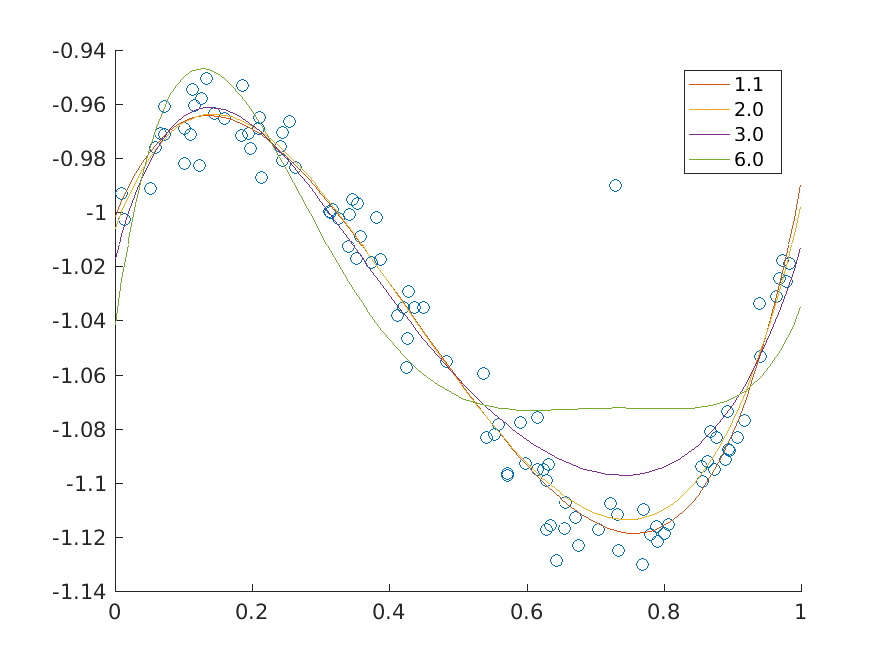
\(p\)-norm minimizing fits of a polynomial of degree at most 5 to the data for various values of \(p\).
Principal Component Analysis (PCA) as Optimization
For centered data matrix \(X\in \mathbb{R}^{n \times p}\) (\(n\) observations and \(p\) variables).
First PC loading vector \(v_1\) can be obtained by solving,
\[ \begin{aligned} \max _{v_1} &\quad v_1^T X^T X v_1,\\ \text{subject to} &\quad v_1^T v_1=1 \quad \text{(length constraint)} \end{aligned} \]
Second PC loading vector \(v_2\) can be obtained by solving, \[ \begin{aligned} \max _{v_2} &\quad v_2^T X^T X v_2,\\ \text{subject to} &\quad v_2^T v_2=1 \quad \text{(length constraint)} \\ &\quad v_2^T v_1=0 \quad \text{(orthogonality constraint)} \end{aligned} \]
PCA as Optimization (contd.)
The \(k\)-th PC loading vector \(v_k\) can be obtained by solving, \[ \begin{aligned} \max _{v_k} &\quad v_k^T X^T X v_k, & \\ \text{subject to} &\quad v_k^T v_k=1 \quad \text{(length constraint)} \\ &\quad v_j^T v_k=0, j=1, \ldots, k-1 \\ &\quad \text{(orthogonality constraint)} \end{aligned} \]
Connection to SVD of \(X = U\Sigma V^T\):
\[ n S=X' X=\left(U \Sigma V'\right)'\left(U \Sigma V'\right)=V \Sigma^2 V' \]
Thus, \(v_k\) is the \(k\)-th right singular vector of \(X\) corresponding to the \(k\)-th largest singular value \(\sigma_k\).
General Mathematical Programming/Optimization
Mathematical Programming/Optimization
A mathematical programming/optimization problem has the form
\[ \begin{array}{ll} \operatorname{minimize}_x & f_0(x) \\ \operatorname{subject to} & f_i(x) \leq b_i, \quad i=1, \ldots, m \end{array} \]
- Optimization variable: \(x=\left(x_1, \ldots, x_n\right)\)
- Objective function: \(f_0: \mathbf{R}^n \rightarrow \mathbf{R}\)
- Constraints: \(f_i: \mathbf{R}^n \rightarrow \mathbf{R}\), \(i=1, \ldots, m\)
- Constraint limits/bounds: \(b_1, \ldots, b_m\)
A vector \(x^{\star}\) is optimal for the problem, if it has the smallest objective value among all vectors that satisfy the constraints.
That is, for any \(z\) with \(f_1(z) \leq b_1, \ldots, f_m(z) \leq b_m\), we have \(f_0(z) \geq f_0\left(x^{\star}\right)\).
Linear Programming Problem
Linear Programming Problem
Optimization problem is called a linear program if the objective and constraint functions \(f_0, \ldots, f_m\) are linear, i.e., satisfy
\[ f_i(\alpha x+\beta y)=\alpha f_i(x)+\beta f_i(y) \]
for all \(x, y \in \mathbf{R}^n\) and all \(\alpha, \beta \in \mathbf{R}\).
Exercise: does \(f(x) = a x + b\) qualify as linear? (assume \(x\) is scalar)
Example: Linear Programming Problem
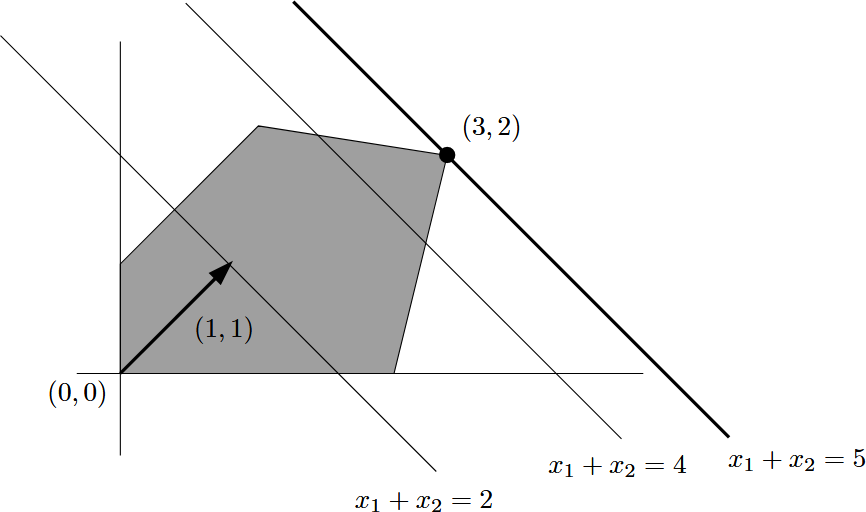
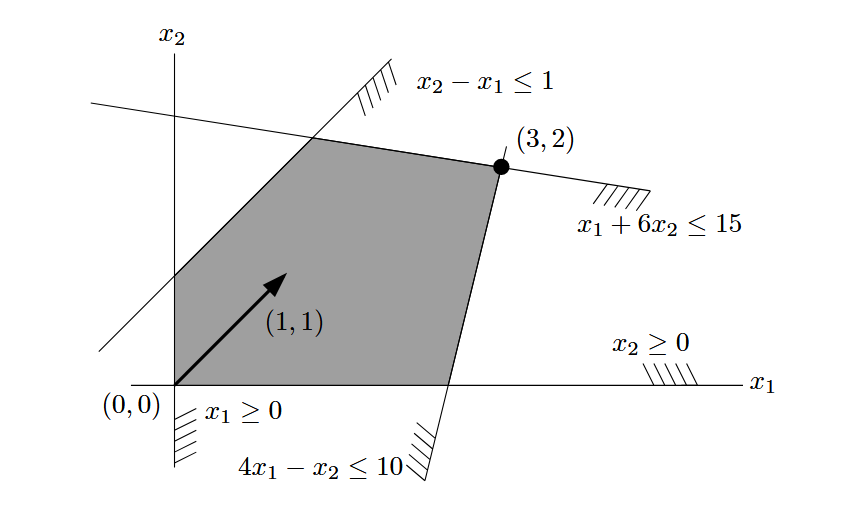
\[ \begin{aligned} \text{maximize}_{\left(x_1, x_2\right) \in \mathbb{R}^2}\quad & x_1+x_2\\ \operatorname{subject to}\quad & x_1 \geq 0,\, x_2 \geq 0 \\ & x_2-x_1 \leq 1 \\ & x_1+6 x_2 \leq 15 \\ & 4 x_1-x_2 \leq 10 \end{aligned} \]
| Food | Carrot, Raw |
White Cabbage, Raw |
Cucumber, Pickled |
Required per dish |
|---|---|---|---|---|
| Vitamin A (mg/kg) | 35 | 0.5 | 0.5 | 0.5 mg |
| Vitamin C (mg/kg) | 60 | 300 | 10 | 15 mg |
| Dietary Fiber (g/kg) | 30 | 20 | 10 | 4 g |
| price ($/kg) | 0.75 | 0.5 | 0.15 | - |
Example: Linear Programming Problem
At what minimum price per dish can the requirements of the Office of Nutrition Inspection be satisfied?
\[ \begin{array}{ll} \text { minimize } & 0.75 x_1+0.5 x_2+0.15 x_3 \\ \text { subject to } & x_1 \geq 0,\, x_2 \geq 0,\, x_3 \geq 0 \\ & 35 x_1+0.5 x_2+0.5 x_3 \geq 0.5 \\ & 60 x_1+300 x_2+10 x_3 \geq 15 \\ & 30 x_1+20 x_2+10 x_3 \geq 4 \end{array} \]
LP Exception Cases
- When a linear program has no feasible solutions, it is called infeasible.
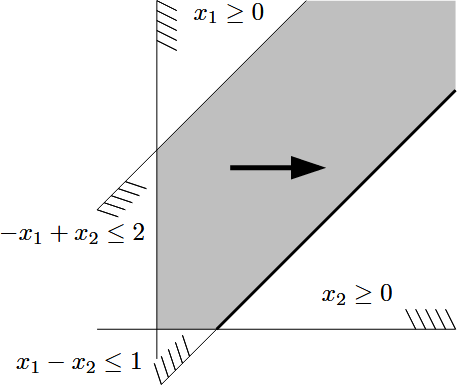
- When a linear program has feasible solutions but can be arbitrarily large in value, it is called unbounded.
- When a linear program has feasible solutions and an optimal solution, but the optimal solution is not unique, it is called degenerate.
LP Exception Cases: Unboundedness
\[ \begin{array}{ll} \operatorname{maximize} & x_1 \\ \text { subject to } & x_1-x_2 \leq 1 \\ & -x_1+x_2 \leq 2 \\ & x_1, x_2 \geq 0 \end{array} \]
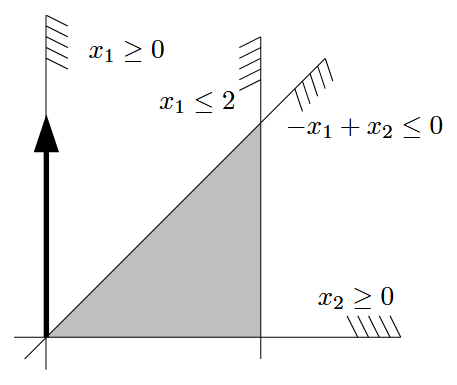
LP Exception Cases: Degeneracy
\[ \begin{array}{lcl} \operatorname{minimize} & x_2 & \\ \text { subject to } & -x_1+x_2 \leq 0 \\ & x_1 \leq 2 \\ & x_1, x_2 \geq 0 \end{array} \]
Standard Form of LP
Standard Form of LP
A linear program can be written in the following standard form:
\[ \begin{array}{ll} \text { Maximize the value of } & \mathbf{c}^T \mathbf{x} \\ \text { among all vectors } \mathbf{x} \in \mathbb{R}^n \text { satisfying } & A \mathbf{x} \leq \mathbf{b}, \end{array} \]
where \(A\) is a given \(m \times n\) real matrix and \(\mathbf{c} \in \mathbb{R}^n, \mathbf{b} \in \mathbb{R}^m\) are given vectors. Here inequality holds for two vectors of equal length if and only if it holds componentwise.
Any vector \(\mathbf{x} \in \mathbb{R}^n\) satisfying all constraints of a given linear program is a feasible solution. Each \(\mathbf{x}^* \in \mathbb{R}^n\) that gives the maximum possible value of \(\mathbf{c}^T \mathbf{x}\) among all feasible \(\mathbf{x}\) is called an optimal solution, or optimum for short.
General Form of LP
Rewriting the standard form of LP explicitly,
\[ \begin{aligned} &\begin{array}{ll} \text { maximize the value of } & \mathbf{c}^T \mathbf{x} \\ \text { among all vectors } \mathbf{x} \in \mathbb{R}^n \text { satisfying } & A \mathbf{x} \leq \mathbf{b}, \end{array}\\ \quad \\ = &\begin{array}{ll} \text { maximize } & \mathbf{c}^T \mathbf{x} =c_1 x_1+c_2 x_2+\cdots+c_n x_n \\ \text { subject to } & a_{11} x_1+a_{12} x_2+\cdots+a_{1 n} x_n \leq b_1 \\ & a_{21} x_1+a_{22} x_2+\cdots+a_{2 n} x_n \leq b_2 \\ & \vdots \\ & a_{m 1} x_1+a_{m 2} x_2+\cdots+a_{m n} x_n \leq b_m \end{array} \end{aligned} \]
Convex Optimization Problem
Linear Programming Problem
Optimization problem is called a linear program if the objective and constraint functions \(f_0, \ldots, f_m\) are linear, i.e., satisfy
\[ f_i(\alpha x+\beta y)=\alpha f_i(x)+\beta f_i(y) \]
for all \(x, y \in \mathbf{R}^n\) and all \(\alpha, \beta \in \mathbf{R}\).
Convex Optimization Problem
A convex optimization problem is one in which the objective and constraint functions are convex, which means they satisfy the following inequality:
\[ f_i(\alpha x+\beta y) \leq \alpha f_i(x)+\beta f_i(y) \]
for all \(x, y \in \mathbf{R}^n\) and all \(\alpha, \beta \in \mathbf{R}\) with \(\alpha+\beta=1, \alpha \geq 0, \beta \geq 0\).